

Nicotinamide Riboside: NAD+ Precursors and What the Trials Measured
Few supplement ingredients have travelled from laboratory obscurity to consumer shelves as quickly as nicotinamide riboside. That speed has produced an unusually wide gap between what the molecule is understood to do in a cell and what has been demonstrated in people.
Both parts are worth setting out honestly, because the gap is the interesting bit.
What NAD+ is
Nicotinamide adenine dinucleotide is a coenzyme present in every cell. It exists in oxidised and reduced states, NAD+ and NADH, and shuttles between them as it carries electrons through metabolic reactions, including glycolysis and the citric acid cycle.
NAD+ has a second role beyond electron transfer. It is consumed as a substrate by several enzyme families, including sirtuins and PARPs, which means the cell is continuously using NAD+ up and continuously resynthesising it.
Cells can build NAD+ from several starting points: from tryptophan, from nicotinic acid, from nicotinamide, and from nicotinamide riboside. These are the NAD+ precursors, and they enter the synthesis pathway at different points.
Where nicotinamide riboside fits
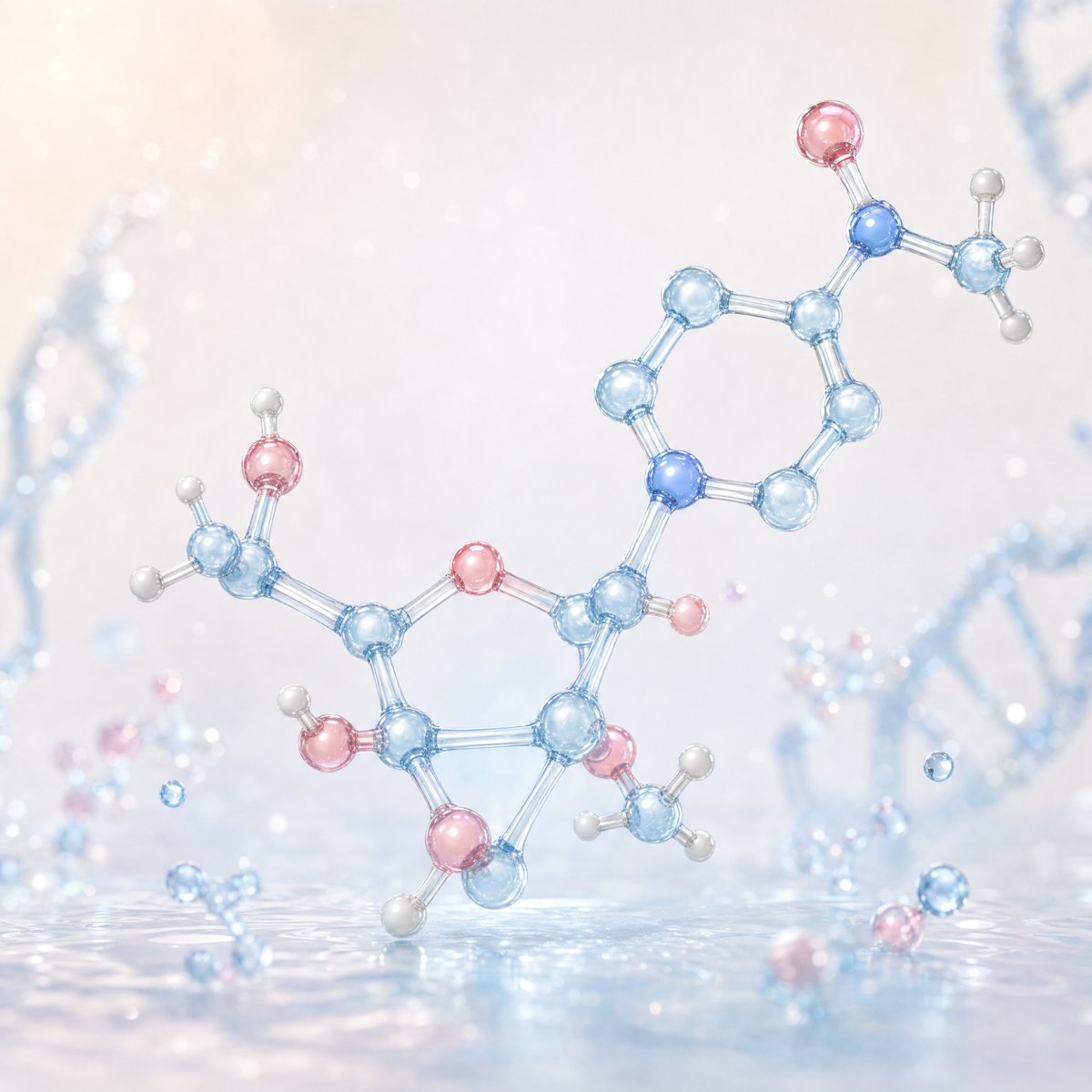
Nicotinamide riboside is nicotinamide attached to a ribose sugar. It was characterised as an NAD+ precursor in yeast and later shown to be present in human milk and in trace amounts in some foods.
Its distinguishing feature is the route it takes. NR is phosphorylated directly by nicotinamide riboside kinases to form nicotinamide mononucleotide, bypassing an enzymatic step required by other precursors. In supplements it is supplied as nicotinamide riboside chloride, a stabilised salt form.
NR and NMN. These are frequently compared. The regulatory position in Great Britain is the more practical distinction: NMN does not have authorised food supplement status here, whereas nicotinamide riboside chloride has been through the GB novel foods process. That is a legal fact about the market rather than a comparison of the molecules.
What the human trials have measured
The consistent and well-replicated finding is that oral NR raises NAD+ levels in human blood. Trammell and colleagues demonstrated this first, and subsequent trials by Airhart, Martens, Dollerup, Elhassan and others have reproduced it across different populations and doses. On the specific question of whether the molecule is absorbed and does what it is proposed to do biochemically, the answer is reasonably settled.
What follows from that is much less settled.
Martens and colleagues ran a randomised crossover trial in healthy middle-aged and older adults and reported changes in some cardiovascular measures, with the authors describing the findings as preliminary and warranting larger studies. Dollerup and colleagues studied obese insulin-resistant men over twelve weeks and found no significant effect on insulin sensitivity or several metabolic endpoints. Elhassan and colleagues examined aged human skeletal muscle and found NAD+ metabolome changes without the mitochondrial functional changes that animal models had suggested.
That is an honest picture: a well-demonstrated biochemical effect, and a set of downstream clinical questions that remain genuinely open. Trial sizes are modest, durations are short, and much of the enthusiasm around NAD+ originates in mouse work.
Delivery
This is a dry liposomal capsule using the SAIFx system, with sunflower lecithin phospholipids and acacia gum.
NR Health Facts
Nicotinamide riboside contributes niacin equivalents. This product provides 105 mg NE, which is 656 percent of the Nutrient Reference Value for niacin.
Niacin contributes to normal energy-yielding metabolism. Niacin contributes to normal functioning of the nervous system. Niacin contributes to normal psychological function. Niacin contributes to the maintenance of normal mucous membranes. Niacin contributes to the maintenance of normal skin. Niacin contributes to the reduction of tiredness and fatigue.
Dose and practical considerations
One capsule provides 250 mg of nicotinamide riboside chloride. Published human trials have used doses ranging from 100 mg to 2,000 mg daily.
Nicotinamide riboside is a nicotinamide-form precursor and does not produce the flushing associated with nicotinic acid.
Anyone pregnant or breastfeeding, anyone taking prescribed medication, and anyone with a diagnosed condition should speak to their GP or pharmacist before starting.
Common questions
What is NAD+? A coenzyme present in every cell, involved in electron transfer in metabolism and consumed as a substrate by enzyme families including sirtuins and PARPs.
What is the difference between NR and NMN? Both are NAD+ precursors entering the pathway at different points. In Great Britain, nicotinamide riboside chloride has authorised food supplement status and NMN does not.
Does nicotinamide riboside raise NAD+ in people? Multiple randomised human trials have reported increases in blood NAD+ levels after oral NR. What that translates to clinically is the open question.
Will it cause niacin flush? Flushing is associated with nicotinic acid. Nicotinamide riboside is a nicotinamide-form precursor.
Why does the label say niacin equivalents? Because nicotinamide riboside contributes to niacin intake, and GB labelling requires that contribution to be declared as niacin equivalents.
References
- Bieganowski P, Brenner C. Discoveries of nicotinamide riboside as a nutrient and conserved NRK genes establish a Preiss-Handler independent route to NAD+. Cell. 2004;117(4):495-502.
- Trammell SAJ, Schmidt MS, Weidemann BJ, et al. Nicotinamide riboside is uniquely and orally bioavailable in mice and humans. Nature Communications. 2016;7:12948. doi:10.1038/ncomms12948
- Airhart SE, Shireman LM, Risler LJ, et al. An open-label, non-randomized study of the pharmacokinetics of the nutritional supplement nicotinamide riboside and its effects on blood NAD+ levels in healthy volunteers. PLoS One. 2017;12(12):e0186459.
- Martens CR, Denman BA, Mazzo MR, et al. Chronic nicotinamide riboside supplementation is well-tolerated and elevates NAD+ in healthy middle-aged and older adults. Nature Communications. 2018;9:1286. doi:10.1038/s41467-018-03421-7
- Dollerup OL, Christensen B, Svart M, et al. A randomized placebo-controlled clinical trial of nicotinamide riboside in obese men. American Journal of Clinical Nutrition. 2018;108(2):343-353.
- Elhassan YS, Kluckova K, Fletcher RS, et al. Nicotinamide riboside augments the aged human skeletal muscle NAD+ metabolome. Cell Reports. 2019;28(7):1717-1728.
- Rajman L, Chwalek K, Sinclair DA. Therapeutic potential of NAD-boosting molecules: the in vivo evidence. Cell Metabolism. 2018;27(3):529-547.
- Great Britain Nutrition and Health Claims Register. Department of Health and Social Care, gov.uk.
Food supplements are not a substitute for a varied and balanced diet and a healthy lifestyle.